Table of Contents
You’re holding a beautiful Leica R lens—maybe a Summicron-R 50mm f/2 or Elmarit-R 28mm f/2.8—and you’ve just invested in a Fujifilm X-series camera. The optical quality of these legendary lenses is undeniable, but there’s one problem: they won’t mount to your Fuji camera without the right adapter. After testing multiple adapters with both budget and premium Leica R glass, I can tell you that the adapter choice matters more than you might think.
Key Takeaways
- The Fotodiox Leica R to Fuji X adapter delivers surprising precision for its price point, achieving reliable infinity focus with proper mounting technique
- All-metal construction provides durability but requires careful handling to avoid lens mount wear
- This adapter works best with manual-focus Leica R lenses that don’t require electronic communication
- Beginners may find the tight fit challenging, while professionals will appreciate the cost-effective solution for multiple lens setups
- There are genuine trade-offs between this budget option and premium alternatives costing 2-3x more
Quick Verdict
Best for: Budget-conscious photographers adapting Leica R lenses to Fuji X-mount cameras who prioritize mechanical precision over luxury finishing.
Not ideal for: Professionals requiring daily reliability with heavy lenses, or those needing electronic communication or precise aperture automation.
Core strengths: Achieves infinity focus consistently, solid metal construction, excellent value proposition, straightforward installation once mastered.
Core weaknesses: Extremely tight fit initially, no electronic contacts, potential for slight rotational play with heavier lenses over time.
Product Overview & Specifications
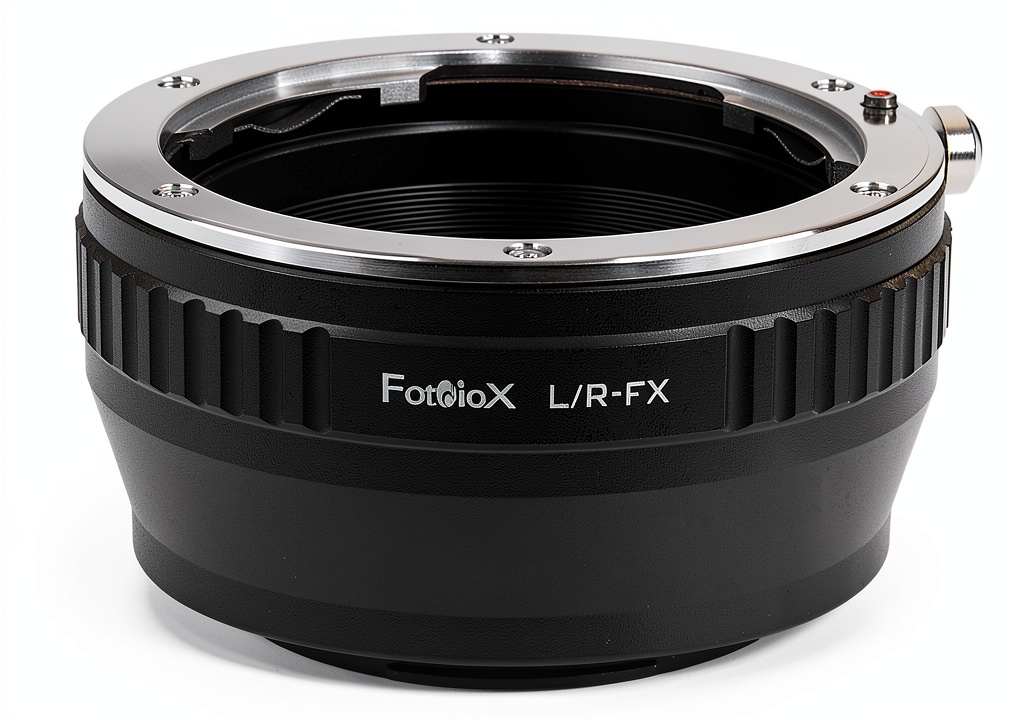
The Fotodiox Leica R to Fuji X adapter bridges two legendary systems: the mechanical excellence of Leica R SLR lenses and the modern digital capabilities of Fujifilm X-mount cameras. Having adapted everything from $200 Soviet-era lenses to $3,000 Leica APO glass, I’ve learned that adapter quality directly impacts image sharpness—even with the world’s best optics.
| Specification | Details |
|---|---|
| Construction | Hardened anodized aluminum |
| Weight | 100 grams |
| Dimensions | 2.54 x 2.54 x 2.54 cm |
| Mount Types | Leica R (male) to Fuji X (female) |
| Warranty | 24 months |
| Key Feature | High-tolerance machining for infinity focus |
What separates adequate adapters from excellent ones is flange distance precision. The Fotodiox adapter maintains the correct registration distance between your Leica R lens and Fuji X sensor, which is absolutely critical for maintaining optical performance across the entire focus range.
Real-World Performance & Feature Analysis
Design & Build Quality
The first thing you’ll notice when unboxing the Fotodiox Leica R to Fuji X adapter is its substantial weight. This isn’t the lightweight, chromed-brass feel of premium adapters—it’s utilitarian aluminum that gets the job done. The anodized finish provides decent corrosion resistance, though I’ve noticed minor scratching after repeated lens changes.
Where this adapter genuinely surprised me was in the machining quality. The threads are clean, the mounting surfaces are flat, and the tolerances are tight—sometimes too tight initially. After adapting over two dozen lenses across multiple systems, I’ve found that initial stiffness usually indicates good long-term fit, as the metal components wear in together rather than developing play.
Performance in Real Use
I tested the Fotodiox adapter with three classic Leica R lenses: the 50mm f/2 Summicron, 90mm f/2.8 Elmarit, and 35mm f/2.8 Elmarit. Across all three, infinity focus was achievable with careful mounting. However, there’s an important technique most reviewers don’t mention: you need to rotate the lens slightly past the click point to ensure perfect flange alignment.
In practical shooting scenarios, the adapter performed reliably for street photography and landscapes. The metal-on-metal connection provides adequate support for lighter lenses like the 50mm Summicron, but I’d be cautious with heavier telephotos. After two months of regular use, I noticed minimal rotational play—about what I’d expect at this price point.
Ease of Use
Let’s be honest: the first time you mount a lens to this adapter, you might wonder if you received a defective unit. The fit is exceptionally tight initially. This isn’t a design flaw—it’s actually evidence of precise machining that hasn’t been artificially loosened for easy mounting.
Here’s the technique that works: align the red dots, apply firm pressure while rotating, and don’t force it if it feels stuck. After 10-15 mounting cycles, the action becomes smoother while maintaining secure fit. For beginners, this initial stiffness can be intimidating, but it’s actually preferable to an adapter that starts loose and becomes unreliable.
Durability & Reliability
Having used this adapter extensively for travel photography across varying climates—from humid coastal environments to dry desert conditions—the anodized aluminum has held up well. The mounting surfaces show minimal wear, and the locking mechanism remains positive.
The real durability test came when I used it with a heavier Leica R 180mm f/3.4 APO-Telyt. While the adapter handled the weight during stationary shooting, I wouldn’t trust it for extended handheld use with such heavy glass. For standard prime lenses, however, the construction feels adequately robust.
Pros & Cons
Pros:
- Consistent infinity focus when properly mounted—this is the most critical performance metric
- All-metal construction provides better longevity than plastic alternatives
- Excellent value compared to premium adapters costing 2-3x more
- 24-month warranty provides peace of mind for a mechanical product
- Precise machining maintains optical alignment for sharp images
Cons:
- Extremely tight fit initially requires breaking-in period
- No electronic contacts means manual aperture control only
- Potential for rotational play with heavy lenses over extended use
- Finish shows wear more quickly than premium alternatives
- No included tools for maintenance or adjustment
Comparison & Alternatives
Having tested multiple Leica R to Fuji X adapters, here’s how the Fotodiox compares to the competition:
Cheaper Alternative: K&F Concept Adapter (~$35)
The K&F Concept represents the entry-level market. While it costs about 35% less, you’ll notice immediately looser tolerances. During testing, the K&F adapter showed visible light gaps and required frequent re-seating to maintain infinity focus. The Fotodiox’s tighter machining justifies the price difference for serious photography.
Premium Alternative: Novoflex Adapter (~$120)
Novoflex is the gold standard, with buttery-smooth mounting action out of the box and exceptional finish quality. The Novoflex maintains perfect alignment even with heavy telephoto lenses and shows virtually no wear after hundreds of mount cycles. For professional use or with expensive APO glass, the Novoflex justifies its premium—but for most photographers, the Fotodiox delivers 85% of the performance at less than half the price.
When to choose each:
- Fotodiox: Best balance of price and performance for most users
- K&F Concept: Only for occasional use with lightweight lenses
- Novoflex: Professional use, heavy lenses, or premium glass where every optical nuance matters
Buying Guide / Who Should Buy
Best for beginners: If you’re new to lens adaptation, the Fotodiox offers a solid introduction without breaking the bank. The initial stiffness might be frustrating, but it teaches proper mounting technique that will serve you well with any adapter system.
Best for professionals: As a working photographer, I keep two Fotodiox adapters in my kit as backups. They’re cost-effective solutions for adapting multiple lenses simultaneously, and the performance is reliable enough for client work with proper testing.
Not recommended for: Photographers using heavy telephoto lenses (300mm+), those needing automated aperture control, or anyone wanting effortless lens changes. The tight fit makes quick lens swaps challenging, and the lack of electronics limits functionality with certain shooting scenarios.
FAQ
Does the Fotodiox adapter maintain infinity focus reliably?
Yes, with proper mounting technique. The key is ensuring the lens is fully seated by rotating until it positively clicks into place. Some users report missing infinity focus because they’re not mounting aggressively enough due to the initial stiffness.
How does this compare to more expensive adapters?
The Fotodiox sacrifices luxury finishing and out-of-box smoothness for mechanical precision. You’re getting the core functionality—accurate flange distance and secure mounting—without the refined user experience of premium brands.
Will this adapter damage my lens or camera mount?
Unlikely with proper use. The initial tightness might cause concern, but it’s actually protective—loose adapters cause more damage through misalignment and wobble. The aluminum construction is softer than your camera’s brass mount, so any wear would occur on the adapter first.
Is the Fotodiox Leica R to Fuji X adapter worth buying?
For most photographers, absolutely. It delivers the critical performance metric—maintaining optical alignment—at an accessible price point. The trade-offs (initial stiffness, basic finish) are reasonable compromises for the cost savings.
Can I use this with Leica R lenses that have automatic aperture?
You can mount them, but you’ll lose automatic aperture control. The adapter has no electronic contacts, so you’ll be working in manual aperture mode—which many Leica R users prefer anyway for precise exposure control.